How to Join Roman Reenactment
“The Roman greatness is a proof of the excellence of their legions.”
—Flavius Vegetius Renatus, Roman military writer. De Re Militari.
The Senate and People of Rome have fought in the SCA, Markland, and Warbands since 1987. We march at Pennsic War, Ragnarok, Armistice, and events across the eastern United States. This guide draws on nearly four decades under the Eagles.
What Is Roman Reenactment?
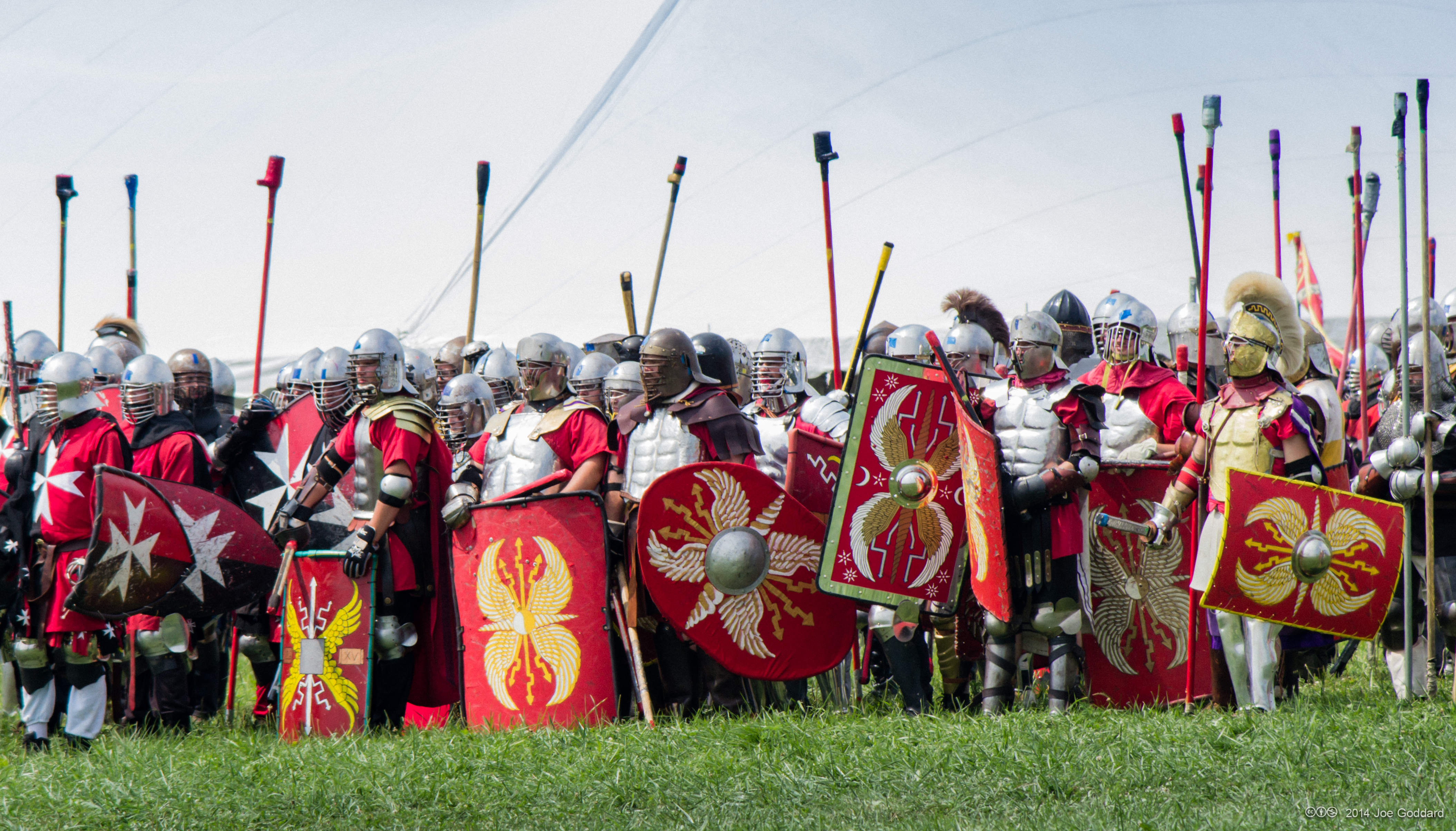
Roman reenactment is living history through combat and culture. Participants build Roman equipment, wear Roman dress, and fight in organized battle scenarios with padded weapons and shields. The serious groups go further: governing by Roman law, holding elections, conferring ranks, keeping records in the manner of the Republic and Empire.
Reenactment splits into two types. Living history groups pursue accuracy through experimental archaeology; correct armor, correct drill, demonstrations to educate and entertain the public. Most skip combat simulation. Rome fights. Depending on the organization, weapons are either foam-padded for full-contact battle without injury, or rattan with armor.
Which Organization Is Right for You
Forget stage combat and LARP. You join a team, march onto a field, and fight people trying to do the same to you. Battles run from under a hundred fighters to thousands. The outcome depends on your side’s skill and coordination.
Several organizations worldwide run mock medieval battles. Rome participates in three, detailed below. Warbands blends history and fantasy; the SCA and Markland stay strictly historical. All three are competitive team sports.
SCA — Society for Creative Anachronism
The largest medieval combat organization in the world, with chapters on every continent. The SCA covers all cultures from roughly 600–1600 AD, including the late Roman period. Combat uses rattan weapons and full armor, heavier and more tournament-focused than foam fighting. The SCA runs its own governance, heraldry, and court structure. Fighting is tightly regulated and chivalry is expected. Events range from small local practices to Pennsic War, which puts two thousand fighters on the field. Rome competes as a recognized Roman unit.
Markland — Markland Medieval Mercenary Militia
Markland is a mid-Atlantic living history organization with a strong emphasis on historical accuracy. Like the SCA, Markland fights with rattan weapons and real armor and allows no LARP or fantasy elements. Its footprint stays regional and its events run tight, with Althyng and Fall War as its flagship gatherings. Rome fields a unit at both.
Warbands Battle Game & Darkon
Warbands is a foam-weapon combat game with minimal historical requirements beyond “pre-gunpowder.” Entry costs less than the SCA, there is no heraldry or court structure, and armor is optional. Head shots are mostly illegal; shield bashing and rear strikes are fair. Darkon runs similarly in the mid-Atlantic but adds LARP elements with character classes and magic. Rome uses Warbands to train newer recruits in fighting and tactics.
The Senate and People of Rome
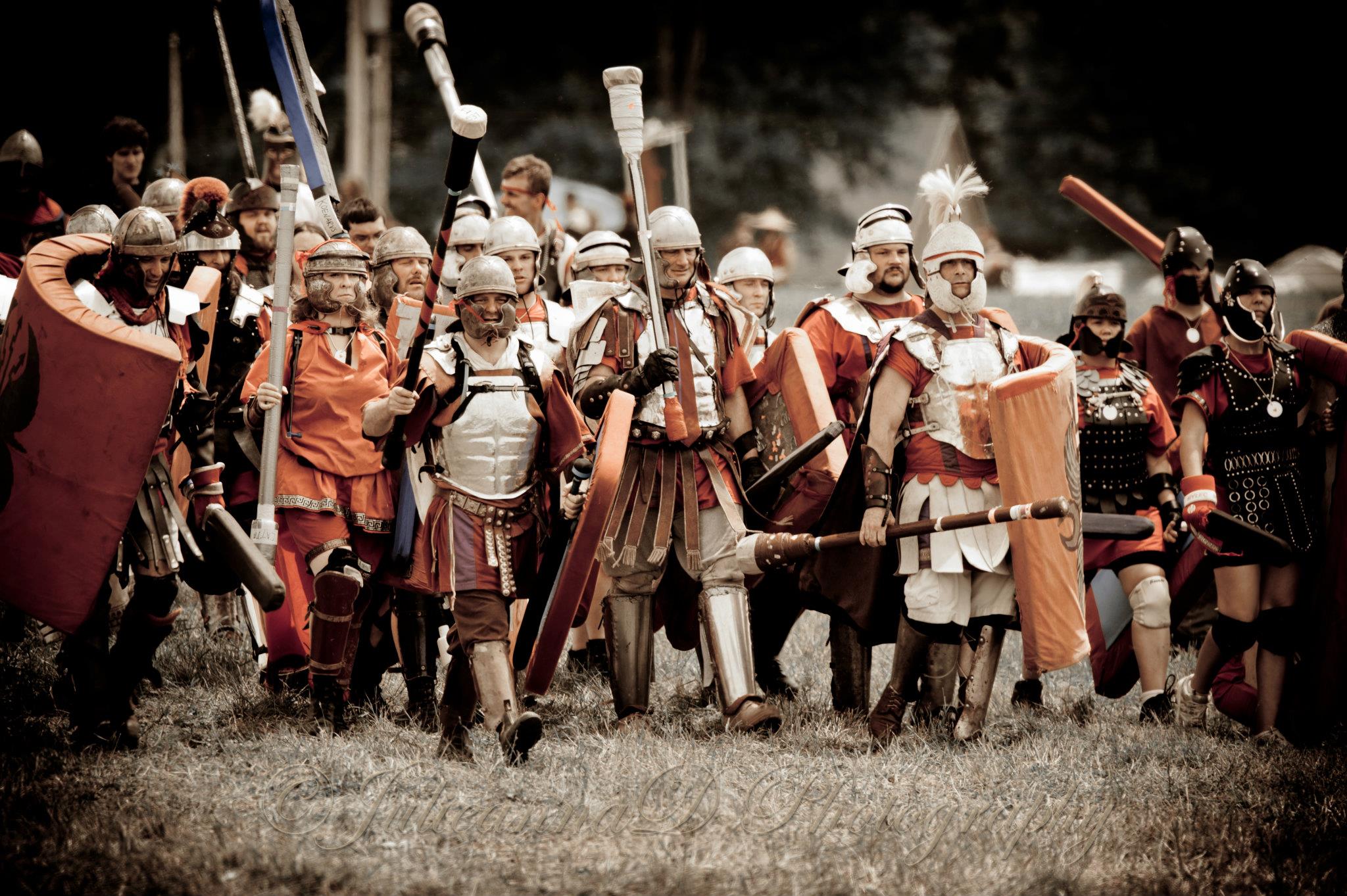
Rome is an organization unto itself. We fight as a Roman unit across all three of these fighting forms. Joining requires only a red tunic and a genuine interest in combat. We have loaner equipment for every fighting form and will help you construct or purchase your own gear. Train at Warbands, fight under the Eagles at SCA events, march with Markland at Althyng and Fall War, muster with us at Armistice in May, form up for Pennsic War in August against an army of a thousand opponents. One group, three theaters of war. See our directory of Roman reenactment groups if you’re looking for a Roman unit in your region.
How to Join Rome: Five Steps
- Attend an event Come to an event before you commit to anything. Our events are on the 2026 campaign schedule. Spectators are welcome and most events are free. Show up, watch a battle, find a soldier in Roman red.
- Read the Mos Maiorum Rome governs itself by a living constitution called the Mos Maiorum, the Way of the Ancestors. It defines ranks, citizenship, rights, obligations, and how decisions are made. Read it before you fight with us. Available as a PDF from romanempire.net.
- Contact Dominus Write to dominus@romanempire.net to introduce yourself and arrange your first event. Dominus commands Rome and handles all new recruit questions personally. Tell him where you are, which events you can reach, and what experience you have.
- Submit your citizen data sheet Before your first battle, fill out the Roman Citizen Data Sheet. It enters your name in the Tabularium, Rome’s register of soldiers, and goes directly to Dominus. Takes five minutes.
- Earn citizenship New fighters begin as Probati, recruits on trial. After six months at local battles or two Wars, the Imperator may offer citizenship. Citizens vote in Rome’s elections and hold military rank and political office. Citizenship is earned in the field.
What Equipment You Need
You don’t need a full kit on day one. Rome works with you on gear as you join. A Roman soldier carries:
Essential (needed to fight):
- Tunica — A red Roman tunic. Sew it from three yards of cotton, linen, or wool, or buy from a vendor. See our recommended vendors.
- Combat or hiking boots — Skip period footwear for fighting.
- Scutum (shield) — The large rectangular Roman shield. Rome’s padded design has held up for decades. Full instructions: How to Make a Padded Shield.
- Gladius and pilum (weapons) — A foam padded sword or javelin. Build your own pilum: How to Make a Padded Javelin.
Not required immediately, added over time:
- Lorica segmentata, hamata, or musculata (segmented, mail, or muscle armor). Citizens learn to build their own lorica musculata as a rite of passage.
- Galea (Roman helmet)
- Ocrae (greaves / shin guards)
- Cingulum (military belt)
What It Costs
| Item | Notes | Est. Cost |
|---|---|---|
| Annual dues | Payable to the Roman Quaestor, set each Consulship | $25/yr |
| Padded shield (DIY) | Plywood, foam, and hardware. Full materials list here. | $80–$200+ |
| Padded weapon (DIY) | PVC or fiberglass core, foam and tape. Full instructions here. | $40–$200+ |
| Roman tunic | Sewn from fabric (cheapest) or purchased from a vendor | $20–$80 |
| Event fees | Varies. Pennsic and Ragnarok charge per week; many regional events are free to watch, but charge a nominal fee for day events. | $5–$120/event |
| Armor (optional) | Lorica segmentata, helmet, etc. Can be purchased or built over time. Not required to start. | $150–$600+ |
Build your own shield and weapon, sew a tunic, and you’re fighting for under $150. Rome charges $25/yr in dues. Add armor as you advance.
Frequently Asked Questions
Do I need prior experience?
No. Rome trains its own soldiers. You don’t need fighting experience, equipment knowledge, or Latin. We teach combat technique, gear construction, and Roman history. Show up willing to learn.
Do I need to know Latin?
No. Latin runs through Rome’s culture, ranks, and ceremonies, but fluency is not required. Ave means hail. SPQR stands for “Senate and People of Rome.” We don’t shout Latin commands in the field; a confused soldier is a liability.
What if I’m not near Rome’s events?
Rome runs in the eastern United States, from upstate New York to western Ohio to Virginia. Members travel from California for Pennsic. Outside that range, the Roman reenactment groups directory covers North America and beyond. Roman units exist in most regions, though few match Rome’s approach to governance and specialization.
Is there a minimum age?
Combat eligibility follows each organization’s rules. The SCA and Warbands have youth programs; Warbands admits participants 16 and older. Contact Dominus for questions about younger participants.
Does Rome use the Testudo formation?
Almost never. The Testudo is a slow and ponderous formation, intended originally for siege work. It renders each fighter in its ranks ineffective, and the fighters in the center of the formation can’t fight at all. Speed is essential in melee. A slow or still unit is usually surrounded and destroyed by its opponents.
What is the difference between a Probatus and a Citizen?
A Probatus is a new fighter on trial. After six months at local battles or two Wars, the Imperator may offer citizenship. Citizens vote in elections, hold rank and political office, and are enrolled in Rome’s rolls permanently. The constitution is not symbolic. Citizenship is earned in the field.
Can I join as a non-combatant?
Rome is a combat unit first. Non-combatant roles exist and matter: camp support, costuming, living history. Contact Dominus to find your place.
The Eagles still fly. Rome wants you!
Submit Your Citizen Data Sheet →Also useful: Roman Reenactment Groups Directory · How to Make a Padded Shield · Roman Vendors & Resources